
The Neonatal Nurses Association (NNA) has now fully explored the Thirlwall Inquiry’s final report and recommendations. In response, the NNA wishes first and foremost to acknowledge the families involved and reassure families that the thousands of neonatal nurses across the UK remain committed to safe, compassionate and evidence-based care.
Addressing some of the report’s key recommendations, Dr Katie Gallagher, Chair of the NNA, said:
“With regard to the issues of workforce, staffing and burnout, The Thirlwall Inquiry has identified what the NNA has been saying for a long time: neonatal nurse staffing and support remains a critical patient safety issue.
‘Neonatal nurses cannot continue to do more in their roles without any additional time and resource. If we are to enhance patient safety and organisational culture, we need enough staff in the right roles with protected time and support.”
The NNA has continually called for funding for quality nursing roles, including specialist roles in bereavement, governance, education and safeguarding.
“This need has been recognised by Thirlwall and many previous inquiries, and yet no new funding has been made available,” Dr Gallagher said. “This must be urgently reviewed if we are to see any meaningful change to neonatal services, and if the new policies identified are to be successfully implemented.”
The NNA welcomes the findings of the Thirlwall Inquiry that support neonatal expertise at Trust Board level.
Dr Gallagher said:
“We have been calling for Heads of Services to have neonatal nursing expertise and will continue to advocate for this service-specific leadership, to support neonatal nursing at all levels through each and every NHS Trust.
‘As an organisation we have repeatedly called for more neonatal nurse expertise within the National Maternity and Neonatal taskforce. There is currently one neonatal nurse informing this critical work, despite calls from the NNA for more neonatal nurse representation. This needs to change. The NNA is ready to support neonatal nurse recruitment to the taskforce.”
The Thirlwall Inquiry has specifically recommended the use of ‘cot cams’ in neonatal services. The Neonatal Nurses Association fully supports the use of small cameras (webcams or ‘cot cams’), placed above an incubator or cot and allowing parents to view a live stream video of their baby. This facilitates bonding between families and the baby when parents cannot be present on the neonatal unit. However, the NNA strongly disagrees with the use of cot cams for neonatal unit surveillance.
“Cot cams are not surveillance monitors,” said Dr Gallagher. “They show the baby in their incubator or cot. Parents will see the hands of neonatal healthcare professionals as they support their baby in routine care or procedures. The livestream is for parent use only and is not monitored by professionals.
‘Cot cams cannot identify any malicious intent, and they cannot prevent deliberate harm. They do, however, risk increasing parental anxiety through witnessing events which may be distressing or when technical difficulties with livestream access arise.
‘Clear communication is required between parents and professionals to explore when webcams will livestream, and what activities will be livestreamed, to minimise any distress and to support parent engagement. The integration of webcam technology into patient care in this way requires ongoing staff training and education. We also need to remember that not all families would have access to this technology.”
The NNA therefore calls for an urgent review of this recommendation, to ensure that millions of pounds are not diverted away from supporting the fundamentals of enhancing neonatal services: the training and development of current and future neonatal nurses.
“Webcams do not care for babies; neonatal nurses do,” said Dr Gallagher. “Currently the funding ringfenced for cot cams would be better spent on increasing staffing levels and improving facilities for Family Integrated Care to support parents to stay with their baby.”
With the undoubted impact of continued reviews on the neonatal nursing community, the NNA acknowledges all members who have supported the ongoing investigations.
Dr Gallagher said: “The NNA will continue to advocate for the voice of our members, to ensure we have funding for increased staffing, better access to training and education, representation at Trust Board level and working conditions that promote wellbeing for nurses and the babies and families they care for.”



 I’m Lora Alexander, one of the Quality Improvement coaches in a busy Level 3 NICU. QI is all about understanding problems, thinking of solutions, implementing ideas and analysing the results.
 My name is Adedoyin Yissau, also known as Dee. I am the Education and Workforce Lead for the London Operational Delivery Network. I came into post as a Network Educator in 2019 and have since developed nursing education region wide, with the current focus on developing a nursing career pathway for London.

 Neonatal Network Nurse Educator
 My name is Dr. Julia Petty, and I am a nurse lecturer specialising in children’s nursing with a particular interest in neonatal care. My nursing career in paediatric and neonatal clinical nursing practice began after a BSc Hons degree in Psychology at Warwick University, when I moved to Great Ormond Street Hospital, London. Here, I trained in children’s and adult nursing before working there for many years in children’s and neonatal surgical care. I then gained my neonatal nursing qualification at St George’s NHS Trust London and worked at the Whittington NHS Trust NICU before moving back to Great Ormond Street for a senior education role on NICU where I worked until 2001. I then worked as Senior Lecturer at City University, London for 12 years leading the neonatal nursing education portfolio. I studied for a MSc, a PGCE and MA in academic practice during this time, In 2013, I moved to the University of Hertfordshire where my role is Associate Professor (learning and teaching) and Senior lecturer child nursing. I teach on the BSc Hons nursing and master’s degree programmes including leadership of modules, face-to-face/online teaching, assessing and supervision of students at all levels up to doctorate level. I am also research active and have completed a Doctorate in Education. As a nurse, educator and post-doctorate researcher, my interests focus on parents’ premature birth experiences, supporting parents in the transition home from NICU, exploring communication needs of neonates and their carers and studying the educational value of digital storytelling. This combination and variety of roles enriches my working life and brings together my experience as a child / neonatal nurse, educator and researcher. My role and related activities enable me to engage in both education and research while supporting students on their nursing career and education pathway, which is a privilege to be part of.
 Hello my name is Claire Richards and I’m the Lead Nurse for the Wales Maternity and Neonatal Strategic Network. This covers nursing leadership but also Neonatal transport. I also have a clinical honorary contract in one Health Board.
 Hello, my name is Kim Edwards, and I am a Neonatal Nurse. I am currently the Lead Nurse and Workforce, Education Lead for the Thames Valley and Wessex Neonatal Operational Delivery Network (ODN)
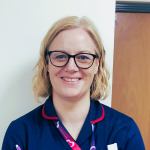
 Hello, my name is Jean and I am a registered children’s nurse with 27 years experience. I qualified with a DipHE after struggling academically due to dyslexia. Over my career I have worked mainly in PICU, NICU and children’s cardiac critical care. I am dual qualified in speciality (QIS) for both Neonatal and Paediatrics. The QIS program is a post graduate modular course completed at level 6/7. To be considered QIS you must successfully complete 4 separate modules, each have an academic and practical component. Only on completion of the QIS course can you apply for a band 6 role. In addition to the above qualifications it is expected you would have several years proven experience in speciality at Band 6 and 7 prior to applying for a Matron’s role.
 My name is Lisa Baker, I’m a Ward Manager on a Level 2 Special Care Baby Unit in South Wales and I’ve been in this role since 2020.
 Hello, my name is Wesell, and I am currently a trainee Advanced Neonatal Nurse Practitioner (ANNP) at Great Western Hospital, which is a Local Neonatal Unit (LNU). Prior to this, I gained substantial experience in a tertiary neonatal unit where I completed my QIS course at master’s level. This course, alongside my role as a senior nurse, provided me with the expertise required to develop my career further in neonatal care.
 My name is Hannah Wells, and I am a Neonatal Surgical Clinical Nurse Specialist (CNS).
 Hi, I am Amanda and work as the Neonatal Infant Feeding Coordinator for a NICU and a SCBU within one service. While the role is not standardised, many neonatal units now have dedicated posts.
 Hello, my name is Daniela Machado, and I am proud to be a Developmental Care Specialist/Lead Nurse and a sister/charge nurse, working across two different trusts. I am originally from Porto, Portugal, and have spent 14 years building my nursing career in the UK. My role involves applying and advancing neuroprotective/developmental care practices for our preterm and neonatal patients/families.
 Hello! I am Renjita Raju , a Neonatal Junior Sister working in London. After completing my BSc nursing degree in India, I moved to UK, and completed NMC OSCE to get registered and QIS course to become specialised in neonatal care. I recently qualified as an NLS instructor with the support from NNA scholarship programme. My role involves caring for premature and critically ill newborns, ensuring their safety and health with a highly collaborative multidisciplinary team. I also teach in NLS courses as an instructor following my passion in neonatal resuscitation. I love witnessing infants grow stronger each day and supporting their families through this journey. I’m grateful for the opportunity to provide meaningful compassionate care to the tiniest, most vulnerable patients.
